
Last Updated: November 12, 2026
Quick Summary
The 7 retinol tips for sensitive skin start with using the lowest strength retinol you can find, applied once a week at night for two to three weeks before increasing frequency. Apply a pea-sized amount to clean, dry skin, and use the retinol sandwich method: moisturizer, then retinol, then moisturizer again.
- Start with a low retinol concentration once a week and treat the first month as a test.
- Apply a pea-sized amount to clean, dry skin at night, skipping the eye area and nose and mouth corners.
- The retinol sandwich method means applying moisturizer, then retinol, then moisturizer again.
- Keep exfoliating acids on separate nights and use benzoyl peroxide in the morning, never with retinol.
- Mild tingling and light flaking are expected adjustment, but spreading redness or swelling means stop.
Table of Contents
- Start With the Lowest Strength Retinol You Can Find
- How Often to Use Retinol for Beginners With Reactive Skin
- Apply to Clean, Dry Skin With a Pea-Sized Amount
- Use the Retinol Sandwich Method for Sensitive Skin
- How to Use Retinol in a Skincare Routine Without Conflicts
- Tell Expected Adjustment Apart From a Real Reaction
- Protect Your Barrier With Moisture and Sunscreen
- Choose Your Retinol and Start Tonight
- Frequently Asked Questions
Start With the Lowest Strength Retinol You Can Find
The single most effective thing you can do with 7 retinol tips for sensitive skin is to begin at the lowest strength available and move slowly. At Coule, we build our formulas around that principle because the research is clear on both sides: retinoids are promising for skin aging, yet irritation like burning, scaling, and dermatitis can limit their use, according to a clinical overview of retinoid efficacy and safety.
Retinoids are molecules that bind to and activate retinoic acid receptors, influencing how skin cells proliferate and differentiate, as described in a clinician's guide to topical retinoids. That mechanism is exactly why they work on fine lines and texture, and exactly why reactive skin needs a gentle on-ramp.
Start with a low concentration, apply it once a week, and treat the first month as a test rather than a treatment. If your skin tolerates that, you have a foundation to build on.
Formulation Matters as Much as Percentage
A low number on the label tells you half the story. The other half is how the retinol is delivered.
When you compare products, read the full ingredient list, not just the strength claim. Our guide to the signs a dual active retinol balm is actually worth it walks through how to judge a formulation before you commit.
How Often to Use Retinol for Beginners With Reactive Skin
Start with once a week, at night, and stay there for two to three weeks. Frequency of use is the lever most beginners pull too hard. A common mistake is applying retinol nightly from day one because the label says "night cream," then quitting entirely when redness and flaking appear.
Once a week lets your skin barrier adapt without a constant challenge. If that week passes without stinging or visible peeling, add a second night. Then a third. Every other night is a realistic goal for many sensitive-skin users, and some skin never needs more than that.
A Week-by-Week Schedule for Building Tolerance
Use this as a starting template, and slow down whenever your skin asks you to.
| Week | Frequency | What to Watch For |
|---|---|---|
| 1 | Once, night 1 | Mild tingling that fades within minutes |
| 2 | Once, night 1 | No new redness or flaking |
| 3 | Twice, spaced apart | Skin feels normal the next morning |
| 4 | Twice to three times | No stinging when you apply moisturizer |
| 5-6 | Every other night | Texture improves without irritation |
| 7+ | Hold at tolerance | Comfort matters more than speed |
If a week goes badly, repeat the previous week rather than pushing forward. Skin acclimation is not a race, and tolerance built slowly tends to hold.
Apply to Clean, Dry Skin With a Pea-Sized Amount
A pea-sized amount is a common starting point for covering the face. More retinol does not mean faster results; it generally means more irritation.
Apply to clean, dry skin at night. Wait a few minutes after cleansing so your skin is fully dry, since damp skin can increase penetration and stinging. A gentle cleanser and patting skin dry rather than rubbing are commonly recommended for sensitive skin.
Skip the eye area and the corners of your nose and mouth on your first attempts. Those zones are thinner and react first. If you want to treat them, apply a thin layer of moisturizer there first as a buffer.
Use the Retinol Sandwich Method for Sensitive Skin
The retinol sandwich method for sensitive skin means applying moisturizer, then retinol, then moisturizer again.
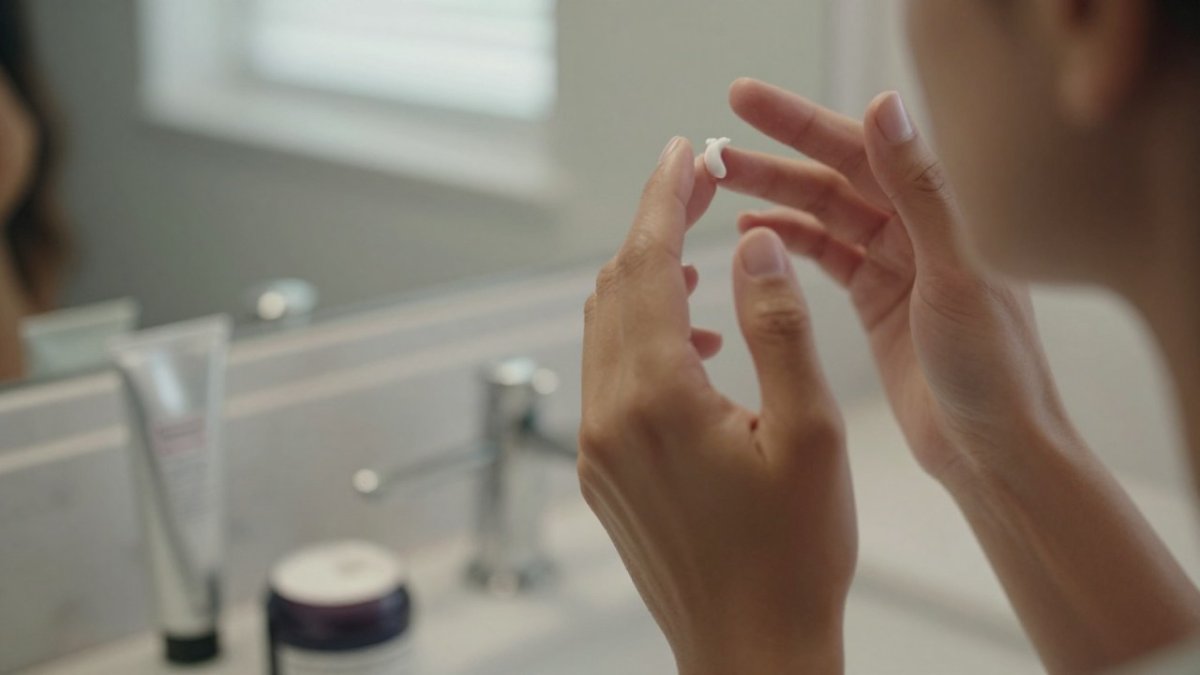
Here is one common order:
- Cleanse gently and pat dry.
- Apply a thin layer of plain, fragrance-free moisturizer and let it absorb.
- Apply your pea-sized amount of retinol over it.
- Wait a few minutes, then apply moisturizer again.
Many people use the sandwich every night at first, then drop the first layer once their skin settles. Watch out: skipping the final moisturizer layer to "let the retinol work better" is the fastest route back to flaking.
How to Use Retinol in a Skincare Routine Without Conflicts
The answer to how to use retinol in a skincare routine is simpler than most routines suggest: retinol goes at night, on clean skin, and most other actives move to other nights. Product layering fails when people stack exfoliating acids, vitamin C, and retinol in the same evening and then blame the retinol for the reaction. The fix is not a longer routine. It is a calendar.
A simple retinol night routine can be cleanser, moisturizer, retinol, moisturizer. Save other actives for the nights in between.
A Complete Compatibility Guide for Other Actives
Retinol competes for the same skin real estate as several common ingredients, and the conflict is usually about timing rather than permanent incompatibility. Here is how to sequence each one.
Exfoliating acids (glycolic, lactic, salicylic, mandelic). Do not use them on the same night as retinol. Both increase cell turnover and can compromise the barrier when stacked, and the combination raises the odds of stinging, redness, and flaking. Put acids on a separate night, and if your skin is reactive, keep at least one full recovery night between an acid night and a retinol night. Start with one acid night per week and hold it there until you know how your skin responds.
Benzoyl peroxide. This is the one to separate most strictly. Benzoyl peroxide can oxidize and degrade retinol, and the pair is notoriously irritating on acne-prone sensitive skin. Use benzoyl peroxide in the morning on affected areas and retinol at night, or alternate nights entirely. If you use a prescription retinoid, ask your clinician before combining the two at all.
Vitamin C. Use vitamin C in the morning and retinol at night. The split is partly practical, vitamin C layers well under sunscreen, and partly tolerability, since both can sting on compromised skin. A common pattern is a vitamin C serum in the morning and retinol two to three nights a week, with the other nights reserved for hydration.
Niacinamide and ceramides. These are generally well tolerated alongside retinol and support the skin barrier. Niacinamide can be layered before or after retinol, and ceramide-rich moisturizers are the backbone of the sandwich method. If you are newly introducing both, add one at a time so you can tell which product is responsible if irritation appears.
Other retinoids (retinal, adapalene, tretinoin). Never stack two retinoids in the same routine. Pick one and build tolerance to it before considering anything else. Prescription retinoids are stronger and follow a different schedule set by your clinician, so do not add an over-the-counter retinol on top.
Peptides. Generally compatible. Peptides can be used in the same routine as retinol, though some formulators prefer to separate them because of pH and stability differences. If your peptide serum stings after retinol, move it to the morning.
Physical exfoliants (scrubs, cleansing brushes). Skip them on retinol nights and for a day after. Mechanical exfoliation plus a retinoid is a reliable way to trigger flaking.
How to Patch Test and Introduce One Active at a Time
Patch test any new active on your jawline for two nights before using it on your full face. Introduce one new product at a time and give it two weeks before adding another, so a reaction can be traced to a single source. If you are already using retinol and want to add an acid, add the acid on a non-retinol night and keep the rest of the routine unchanged for two weeks.
Watch out: the most common layering mistake is adding a new exfoliant during the first month of retinol use, when the barrier is still adapting and almost any addition will be blamed on the retinol.
If uneven tone is your main concern, our guide on how to treat hyperpigmentation with retinoids covers which combinations make sense and which to space out.
Tell Expected Adjustment Apart From a Real Reaction
Mild tingling, light flaking around the nose, and a bit of dryness in the first two weeks are expected adjustment. A real reaction looks different: spreading redness, swelling, burning that does not settle, or a rash that appears on areas you did not apply product to. The distinction matters because the right response is opposite in each case, adjustment means hold steady, while a reaction means stop.
Use this decision tree:
- Tingling that fades in minutes and no visible redness: continue at the same frequency.
- Flaking that clears with moisturizer: reduce to once a week for two weeks, then rebuild.
- Stinging when you apply moisturizer: stop retinol until the stinging stops, then restart at a lower frequency.
- Swelling, hives, or a rash beyond the application area: stop using it and speak with a dermatologist.
Sensitive-Skin Conditions and When to Consult a Dermatologist
Reactive skin is not one thing, and the condition behind your sensitivity changes whether retinol is appropriate at all.
Eczema. Retinol is more likely to sting and flare during an active eczema outbreak. Wait until the skin is calm and the barrier is intact before starting, and ask a dermatologist whether a low-strength retinoid is appropriate for your skin. Do not apply retinol to broken, weeping, or actively inflamed patches.
Rosacea. Many people with rosacea tolerate a low-strength retinol once the condition is stable, but retinol can trigger flushing and stinging during a flare. A dermatologist can advise on timing and whether a prescription retinoid is a better fit than an over-the-counter formula.
Compromised skin barrier. Signs include tightness, stinging when water touches your face, and products that used to be comfortable suddenly burning. Do not start retinol on a compromised barrier. Spend two to four weeks on gentle cleansing and barrier moisturizers first, then begin at once a week.
A history of contact dermatitis or known fragrance sensitivity. Choose a fragrance-free, minimal-ingredient formula, and patch test for longer than two nights before applying to the full face.
Seek professional advice before starting retinol if you are pregnant or breastfeeding, are using a prescription retinoid or other prescription acne treatment, have recently had a chemical peel or laser treatment, or have a skin condition that is currently active rather than stable. A dermatologist can also rule out a reaction that looks like irritation but is actually an allergy.
What to Do If You Think You Are Reacting
Stop the product, not just the frequency. Return to a plain gentle cleanser and a fragrance-free moisturizer, and skip all other actives until the skin is calm. If the reaction is mild and settles within a few days, you can restart at once a week after two clear weeks. If it involves swelling, hives, blistering, or a rash that spreads beyond where you applied product, stop and contact a dermatologist or a pharmacist rather than restarting on your own.
Watch out: pushing through burning or swelling because a week-by-week schedule says to increase frequency is the most common way a manageable adjustment becomes a genuine reaction.
If you have rosacea, eczema, or very reactive skin, retinol may not suit you at all, and a dermatologist is the right person to make that call. There is no prize for pushing through a reaction.
Protect Your Barrier With Moisture and Sunscreen
Sunscreen is not optional on a retinol routine. Retinoids can make skin more sensitive to UV exposure, so a broad-spectrum sunscreen every morning is part of the treatment, not an add-on. Reapply when you are outside for long stretches.
Barrier repair happens overnight, which is why hydration matters so much. Look for moisturizers with ceramides, glycerin, or squalane, and apply them generously on retinol nights and the mornings after. A damaged skin barrier shows up as tightness, stinging, and dullness long before it shows up as visible peeling.
Two habits make the biggest difference: keep your cleanser gentle, and do not add a new exfoliant while you are still building retinol tolerance.
Choose Your Retinol and Start Tonight
Our hero product is a dual active retinol balm in a sleek aluminum tube, formulated for both men and women.
If you want a deeper primer before you begin, read our gentle retinol guide for sensitive aging skin. You can also browse the French pharmacy skincare collection to compare options, or go straight to the low-irritation retinoid night cream and start with one product rather than a full routine.
Sensitive skin does not have to sit out retinoids. It needs a low strength, a slow schedule, and a formulation built to protect the barrier while the active works. Coule's dual active retinol balm is designed around exactly that balance, with an encapsulated formula in an aluminum tube that dispenses a controlled, pea-sized amount. Get started with Coule and build a retinol routine your skin can actually keep.
Frequently Asked Questions
How often should beginners with sensitive skin use retinol?
Start with once a week at night, then move to every other night after two to three weeks if your skin stays calm. From there, you can build toward three or four nights a week. Daily use is not the goal for reactive skin; consistent, tolerable use is. If redness or stinging lingers more than a day, drop back to your last comfortable frequency before increasing again.
Should you apply moisturizer before or after retinol?
Both work, and the order depends on your skin. Applying moisturizer first, then retinol, is the core of the retinol sandwich method for sensitive skin: it buffers the active and slows absorption. Applying retinol first on clean, dry skin and moisturizer after is the standard approach for skin that has already built tolerance. Beginners and anyone with a compromised barrier should start with moisturizer first.
How long does retinol irritation usually last?
Mild dryness, flaking, or light redness during the first two to four weeks is common and typically settles within a few days of each application. A clinical overview in Clinical Interventions in Aging notes that burning, scaling, and dermatitis can limit retinoid use, which is why frequency matters. Irritation that lasts more than a week, or involves swelling, blistering, or pain, is not normal adjustment and warrants stopping use and seeing a dermatologist.
What should you avoid using with retinol?
Keep exfoliating acids like glycolic and salicylic acid, benzoyl peroxide, and high-strength vitamin C out of the same evening routine while you are acclimating. These actives compound irritation and can damage the skin barrier. Use them on alternate nights or in the morning instead. Gentle cleansers, ceramide moisturizers, niacinamide, and sunscreen layer safely with retinol.
Can you use retinol around crow's feet and under the eyes?
Yes, with care. The skin around the eyes is thin and prone to dryness, so apply a small amount of low-strength retinol around crow's feet only after your eye area has tolerated it elsewhere on the face. Avoid the upper eyelid and the immediate under-eye area unless a product is formulated for it. Pair with a moisturizer, and stop if stinging or flaking develops.
